Intercom Pricing Explained: Plans, Fin AI & Hidden Costs
Intercom pricing starts at $29/seat/month plus $0.99 per Fin AI resolution. Full breakdown of plans, hidden costs, add-ons, and what pricing teams can learn.
Quick Summary: Intercom pricing uses a hybrid model: seat-based platform access ($29–$132/seat/month across three tiers) plus usage-based AI at $0.99 per Fin AI resolution. Unlike most AI tools that charge per token or API call, Intercom only charges when Fin successfully resolves a customer conversation — a true outcome-based pricing model. Total costs depend on team size, AI resolution volume, and add-ons like Copilot ($29/agent/month) and channel fees for SMS/WhatsApp. A 10-person team handling 5,000 monthly AI resolutions typically pays $1,300–$1,800/month all-in — significantly less than hiring equivalent human agents.
About Intercom
Intercom is a customer service platform founded in 2011, serving over 25,000 businesses worldwide. Their flagship product is a next-generation helpdesk combined with Fin AI Agent, which they market as the #1 AI agent for customer service. Fin claims to resolve 59% of customer queries autonomously across channels including live chat, email, phone, and social media.
The core value proposition: Replace expensive human support teams with AI that handles routine queries, while routing complex issues to human agents. This promises cost savings of 60-80% on support operations while maintaining high customer satisfaction.
How Does Intercom’s Pricing Model Work?
Intercom pricing is built on a hybrid architecture with two dimensions:
- Platform Access (Seat-Based): $29–$132 per seat/month based on tier (Essential, Advanced, Expert)
- AI Resolution (Usage-Based): $0.99 per successfully resolved customer conversation via Fin AI Agent
What makes this different: Unlike most AI products that charge per API call, token, or query, Intercom charges only for successful outcomes. This outcome-based pricing creates powerful alignment — Intercom only profits when they deliver value.
What Are Intercom’s Three Pricing Tiers?
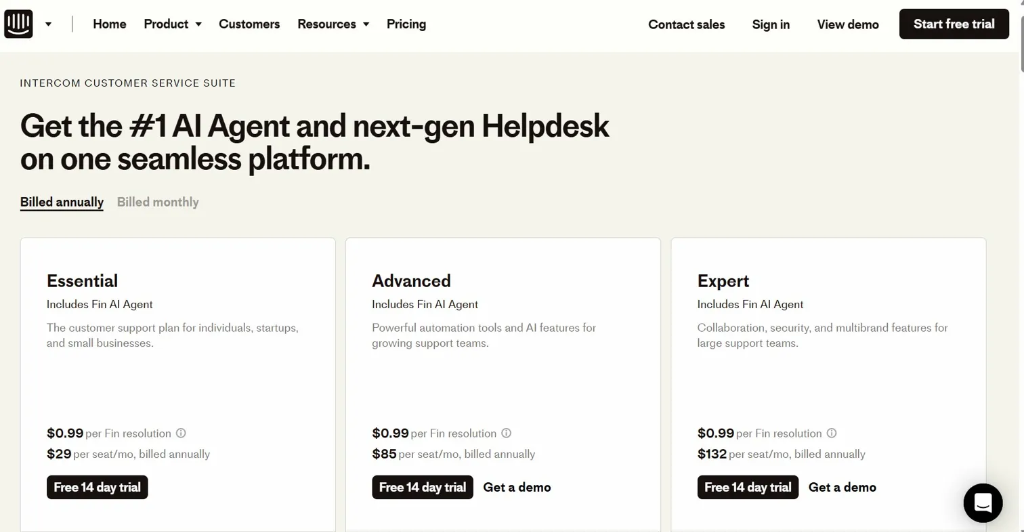
| Feature | Essential | Advanced | Expert |
|---|---|---|---|
| Seat Price (Annual) | $29/seat/mo | $85/seat/mo | $132/seat/mo |
| Fin AI Resolution | $0.99 | $0.99 | $0.99 |
| Target Customer | Startups, SMBs | Growing teams | Large enterprises |
| Free Lite Seats | 0 | 20 | 50 |
| Key Features | Shared inbox, basic ticketing, public help center | + Workflows, round robin, private help center | + SSO, HIPAA, SLAs, multibrand |
Intercom also offers an Early Stage Program with up to 90% discount for qualifying startups with fewer than 25 employees and under $5M in funding — making the Essential plan as low as ~$3/seat/month.
What Are the Hidden Costs in Intercom Pricing?
The advertised per-seat price is only part of the story. Here’s what your actual Intercom bill includes:
Real-World Cost Example
A 10-person support team on the Advanced plan ($85/seat) handling 5,000 Fin resolutions monthly:
| Line Item | Monthly Cost |
|---|---|
| 10 seats × $85 | $850 |
| 5,000 Fin resolutions × $0.99 | $4,950 |
| Copilot (5 agents × $29) | $145 |
| Proactive Support Plus | $99 |
| Total | $6,044 |
Compare this to the advertised “$85/seat/month” and you can see why understanding the full cost structure matters. The Fin resolution fees alone can exceed the platform seat costs at moderate volumes.
Usage-Based Channel Fees
Beyond Fin resolutions, Intercom charges usage fees on variable-cost channels:
- WhatsApp: Per-conversation pricing, varies by volume and direction (inbound vs. outbound)
- SMS: Per message sent/received, varies by region and volume
- Email Campaigns: Per bulk email sent (inbox emails are unlimited)
- Phone: Usage-based (custom pricing via Fin Voice)
Core platform features (live chat, inbox, help center) remain unlimited. Variable-cost channels that create direct costs for Intercom are passed through on a usage basis.
How Does Intercom’s Bundling Strategy Work?
Fin as a Platform Feature vs. Standalone
Intercom employs a dual-packaging strategy for Fin AI Agent:
-
Bundled with Intercom Suite: Included in all three platform tiers at the same $0.99/resolution price. This bundles AI capabilities with traditional helpdesk features.
-
Standalone for Competitors: Can be deployed on Zendesk, Salesforce, or other existing helpdesks. Still $0.99/resolution with a 50 resolution/month minimum, no seat costs.
Strategic insight: This is a land-and-expand strategy. The standalone option removes switching costs for prospects locked into competitor platforms, while the bundled option creates retention gravity for existing Intercom customers.
What Add-Ons Does Intercom Offer?
| Add-On | Pricing | Value Proposition |
|---|---|---|
| Copilot | $29/agent/mo (unlimited use) or 10 free conversations/agent/mo | AI assistant in agent inbox for faster responses |
| Proactive Support Plus | $99/mo (includes 500 messages sent) | Product tours, surveys, in-app posts, mobile push |
Notice the freemium aspect — 10 free Copilot conversations per agent monthly creates product-led growth within accounts. Teams try it, love it, then pay for unlimited.
What Does Intercom’s Pricing Page Get Right?
Strengths
- Transparent Resolution Pricing: The $0.99 per resolution is prominently displayed across all tiers. No hiding the usage metric.
- Standalone Fin Option Visibility: The page clearly presents Fin as available for Zendesk/Salesforce users, lowering perceived switching costs.
- Comprehensive FAQ: Extensive accordion-style FAQ addresses pricing mechanics, resolution definition, and edge cases.
- Social Proof: Customer testimonials with specific metrics (70% resolution rate, 97% CSAT) build confidence in the value metric.
What Are the Weaknesses in Intercom’s Pricing Page?
- Buried Cost Estimator: The pricing calculator is positioned low on the page. For usage-based pricing, this should be hero content — not a secondary CTA.
- No Example Scenarios: The page lacks concrete examples. What does a company with 100,000 monthly support conversations actually pay? Showing 2-3 customer archetypes with total cost breakdowns would dramatically improve clarity.
- Resolution Definition Ambiguity: While the FAQ explains resolutions, it’s buried. The pricing cards should include a tooltip defining what counts as a resolution. There’s also the “soft resolution” controversy — conversations where a customer silently exits may count as resolved, potentially inflating costs.
- Mixed Pricing Models Create Confusion: Seat-based platform + per-resolution AI + per-message channels + monthly add-ons = cognitive overload. The page tries to explain too many pricing dimensions simultaneously.
- Lite Seat Explanation Gap: Advanced includes 20 free Lite seats, Expert includes 50. What’s a Lite seat? Why does it matter? This is mentioned but not explained in the comparison table.
How Do Intercom’s Pricing Calculators Work?
1. Pricing Calculator
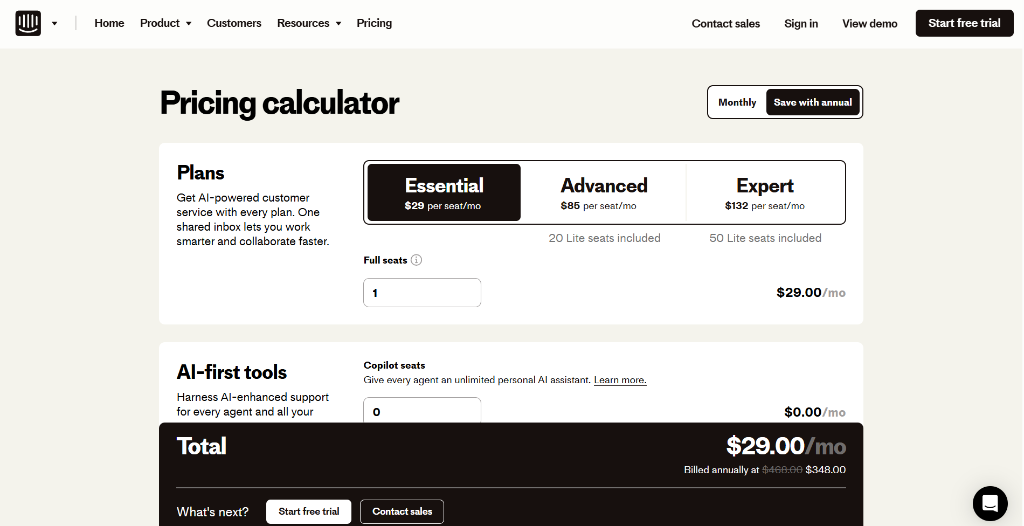
Purpose: Estimate total cost based on team size, expected Fin resolutions, and feature selection. Try the calculator here.
Strengths: Helps prospects understand their actual monthly bill by inputting real data.
Weakness: Requires users to estimate resolution volume before they understand what a resolution is. Cart before the horse.
Want to estimate your Intercom costs? Try our Intercom Fin AI Pricing Calculator to model your monthly bill based on team size and resolution volume.
2. ROI Calculator (Fin Savings Estimator)
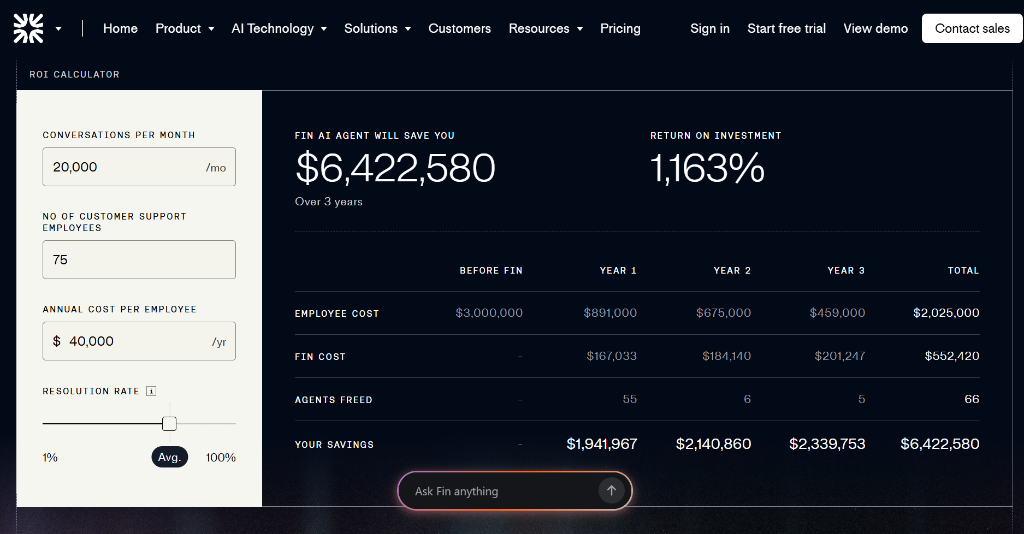
Purpose: Shows potential time and cost savings based on current support volume. Check your savings here.
Strengths: Value-focused rather than cost-focused. Positions Fin as a cost-saver, not expense.
Critical Missing Element: No comparison showing cost vs. hiring additional support agents. This would be the killer stat for CFO-level conversations.
What Did Intercom Get Right Strategically?
1. Outcome-Based Pricing Reduces Risk
By charging per resolution rather than per query or per token, Intercom shoulders quality risk. If Fin fails to resolve a conversation, the customer doesn’t pay. This is rare in SaaS and creates trust.
2. Price Anchoring at $0.99
The sub-dollar pricing feels like a bargain psychologically. Compare to the cost of a human agent answering one support ticket (estimated $5–15 in labor costs). The value prop is immediate.
3. Minimum Commitment Creates Floor Revenue
The 50 resolution/month minimum for standalone Fin creates a predictable revenue floor while still maintaining usage-based benefits above that threshold. Smart risk mitigation.
4. Platform Lock-In Through Bundling
Including Fin in all platform tiers at the same resolution price means customers have no incentive to leave Intercom for competitors. The AI becomes a retention moat.
What Could Intercom Improve About Their Pricing?
1. Lead with Outcome Economics, Not Feature Lists
The pricing page focuses heavily on features (inbox, tickets, workflows). Instead, lead with customer outcomes and total cost of ownership. Show a comparison:
- Hiring 5 more support agents: $300,000/year
- Intercom with Fin (handling same volume): $85,000/year
Make it visceral. Use big numbers. Make the CFO’s jaw drop.
2. Interactive Resolution Calculator Should Be Hero Content
The calculator is the most important element for usage-based pricing. It should be:
- Above the fold
- Pre-filled with industry benchmark data
- Showing a live total cost estimate as you adjust inputs
- Including a breakdown: “Your estimated bill: $X for platform seats + $Y for Fin resolutions = $Z total”
3. Add Customer Story Microsites with Real Numbers
The testimonials mention metrics (70% resolution rate), but not costs. Create 3-4 detailed case studies showing:
- Company size and support volume
- Intercom tier selected
- Monthly Fin resolutions
- Total monthly cost
- ROI realized (time saved, agents redeployed, customer satisfaction)
Transparency builds trust. Show the receipts.
4. Explain Variance: Why Bills Fluctuate Month-to-Month
Usage-based pricing creates bill variability. Address it head-on with:
- Seasonal volume patterns (e.g., e-commerce spikes in Q4)
- How to set budgets with buffer
- Alert systems when you approach spend thresholds
- Spend caps or commitment discounts for predictability-focused buyers
Finance teams hate surprises. Give them tools to plan.
5. Create a Pricing Tier for ‘AI-First’ Buyers
The current tiers differentiate on features (workflows, SLAs, SSO). But there’s a missing archetype: the company that wants Fin + minimal platform.
Consider a “Fin Essential” tier:
- $0.99 per resolution
- $15/seat/month (lower than current Essential)
- Stripped down platform features — just basic inbox and Fin
- Target: AI-native companies who want to run support 90% through Fin
6. Visualize the Economics of Scale
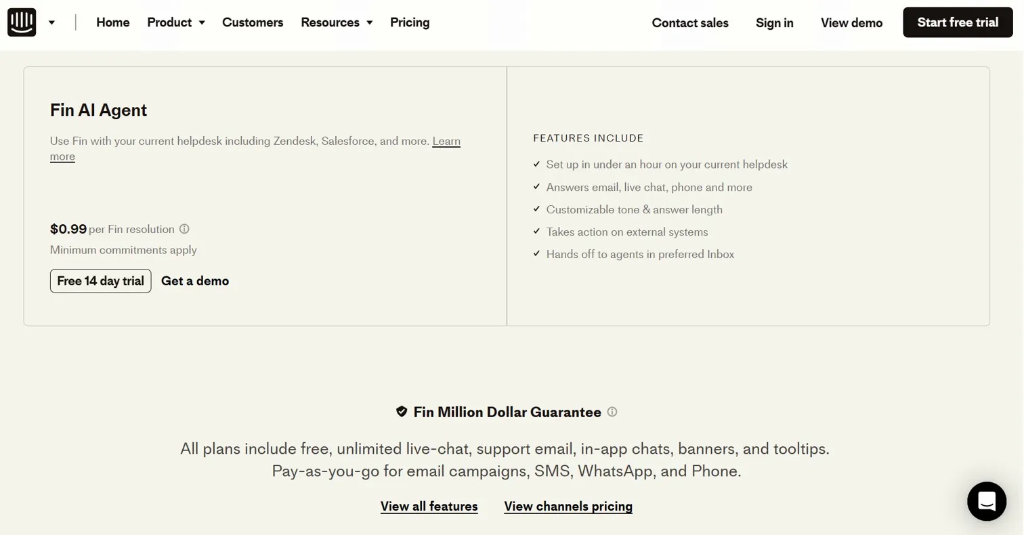
Show a graph: “As your support volume grows, cost per ticket shrinks.” Demonstrate how Fin becomes more cost-effective at scale compared to linear hiring costs.
Key Takeaways for Pricing Teams
Intercom’s Fin pricing is a masterclass in aligning incentives between vendor and customer. Here’s what SaaS pricing teams can learn:
-
Charge for outcomes, not inputs: Resolutions, not API calls. This is the clearest example of value-metric pricing in B2B SaaS.
-
Hybrid models reduce customer risk: Predictable base (seats) + variable value (resolutions).
-
Transparent calculators build trust: Make them hero content, not footer CTAs.
-
Bundle strategically for retention: Fin included across tiers creates platform stickiness.
-
Show real customer economics: Case studies with actual costs are worth 100 feature lists.
The Bottom Line
The biggest opportunity? Intercom should lean harder into being the “CFO-friendly AI solution.” Show the math. Make the ROI undeniable. Turn pricing pages into business cases.
Their resolution-based pricing is already industry-leading. Now they need to tell that story better.
Frequently Asked Questions
What is a “resolution” in Intercom’s Fin AI pricing?
A resolution is counted when Fin AI successfully handles a customer conversation without needing a human agent. The customer’s query must be answered or their issue resolved for Intercom to charge the $0.99 fee. However, there is some ambiguity around “soft resolutions” — conversations where a customer stops responding may still count.
How much does Intercom actually cost per month?
It depends on your team size and AI usage. A 5-person team on the Essential plan ($29/seat) with 2,000 monthly Fin resolutions would pay roughly $2,125/month ($145 seats + $1,980 resolutions). Add Copilot and channel fees, and the real cost can be 2-3x the advertised per-seat price.
Can you use Fin AI without the full Intercom platform?
Yes. Intercom offers Fin as a standalone product that integrates with Zendesk, Salesforce, and other helpdesks. Pricing is the same $0.99/resolution with a 50 resolution/month minimum ($49.50/month floor). No seat-based fees apply.
How does Intercom pricing compare to hiring support agents?
A single support agent costs roughly $40,000–$60,000/year (fully loaded). At $0.99/resolution, Fin would need to handle ~50,000 resolutions/year to match one agent’s cost ($49,500). If Fin handles routine queries (typically 50-60% of volume), the math strongly favors AI at scale.
Does Intercom offer discounts for startups?
Yes. The Early Stage Program offers up to 90% off for startups with fewer than 25 employees and under $5M in funding. This makes the Essential plan as low as ~$3/seat/month — one of the most aggressive startup programs in customer service software.
Part of the UsagePricing.com pricing analysis series
Intercom Pricing History
Usage-Based AI Formalization
Formalized usage-based pricing model for AI products, cementing the $0.99/resolution fee.
Fin AI Pricing Launch
Introduced the industry-first $0.99 resolution-based pricing for Fin AI Agent.
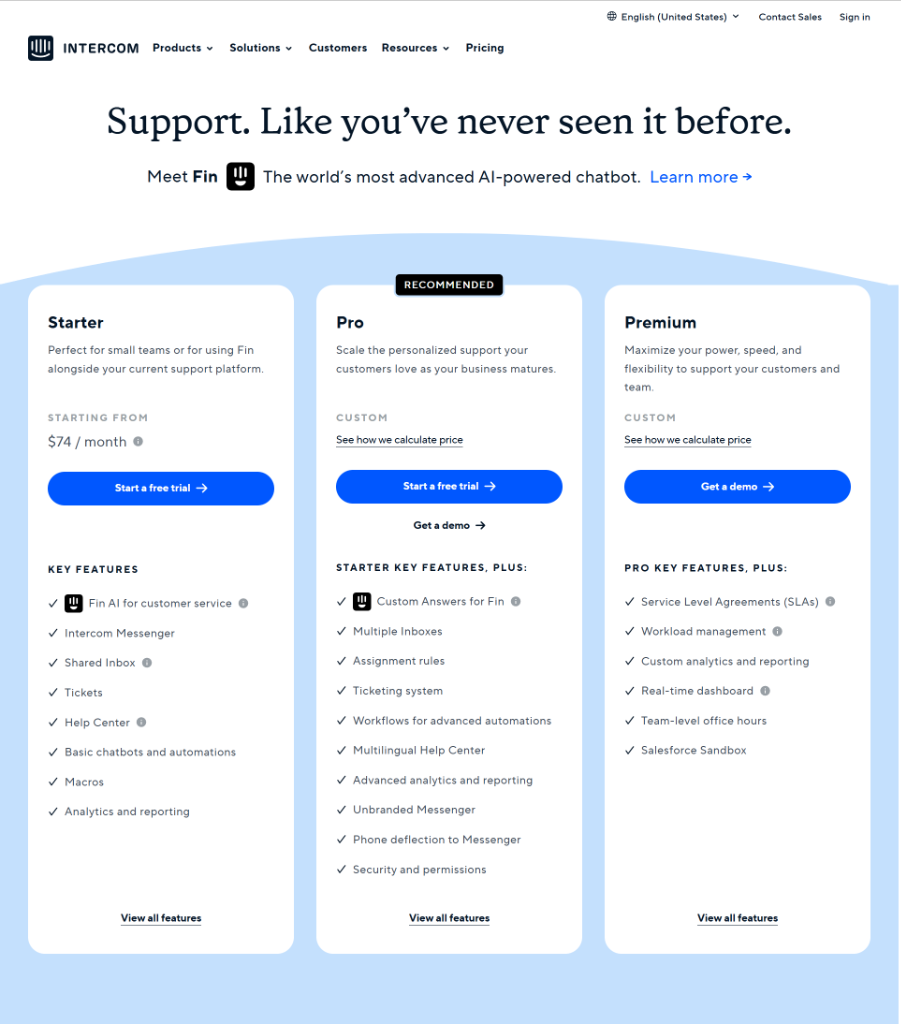
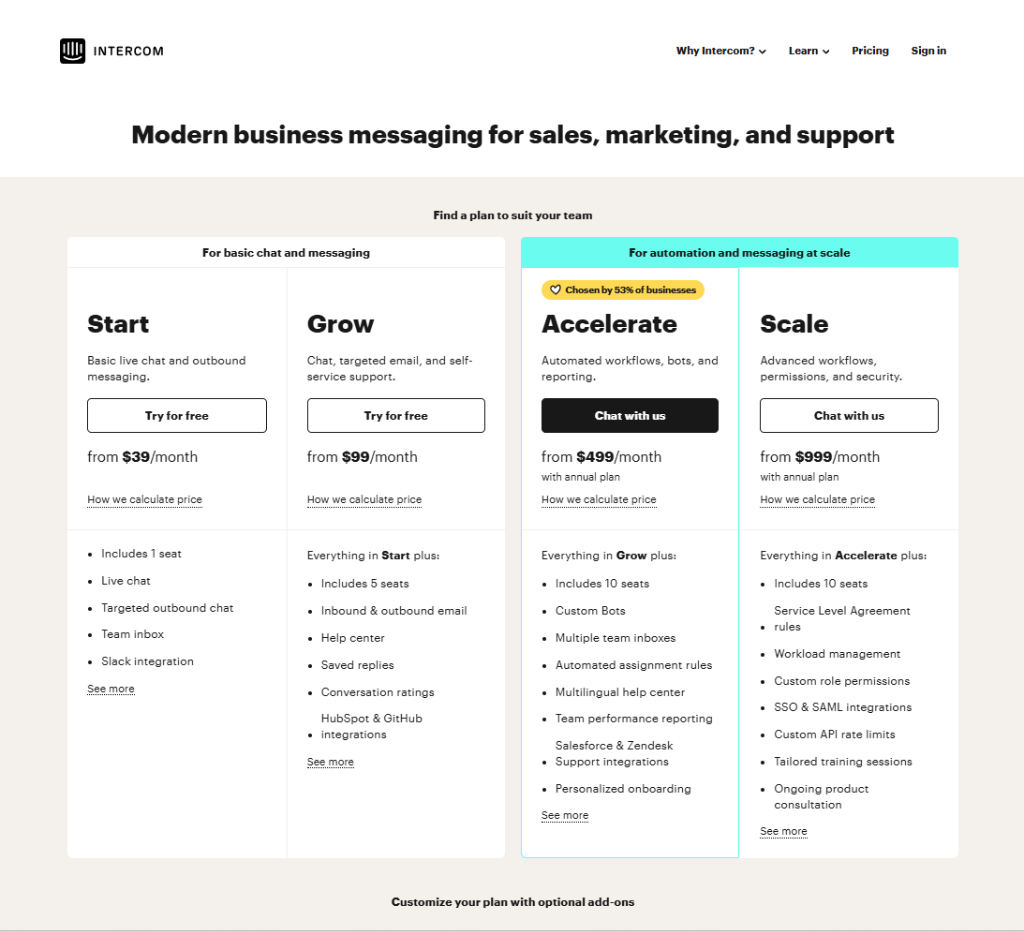
Contextual Pricing Era
Introduced the 'Start, Grow, Accelerate, Scale' methodology, focusing on varying feature sets for different company stages.
Conversation-Based Pricing
Shifted from user-based to conversation-based pricing for support tools.
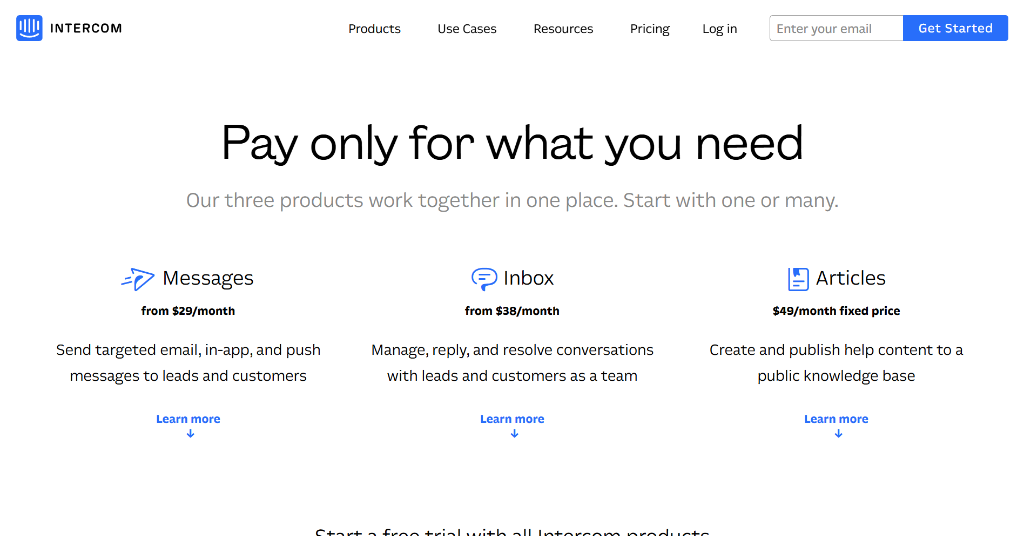
Modular Unbundling
Shifted to unbundled 'a la carte' pricing for Messages, Inbox, and Articles to allow modular adoption.
Active User Pricing
Moved strictly to 'Active People' pricing, removing the confusing lead/user distinction.
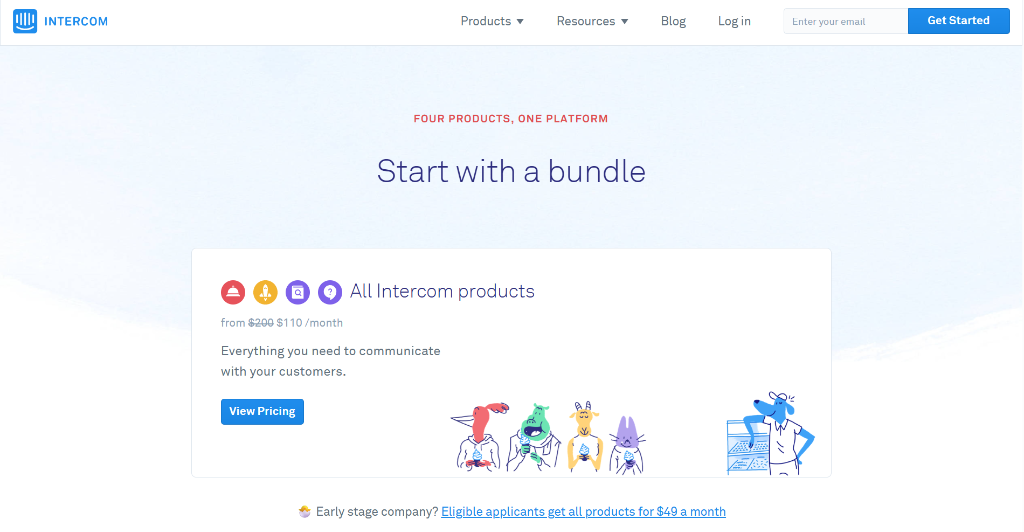
The Bundle Era
Intercom has always used bundling as a core lever ('Start with a bundle'), initially for product suites, now for AI + Helpdesk.
Early Seat-Based Pricing Launch
Started with a simple sliding scale based on the number of active users.